Green Acre: The Last Garden

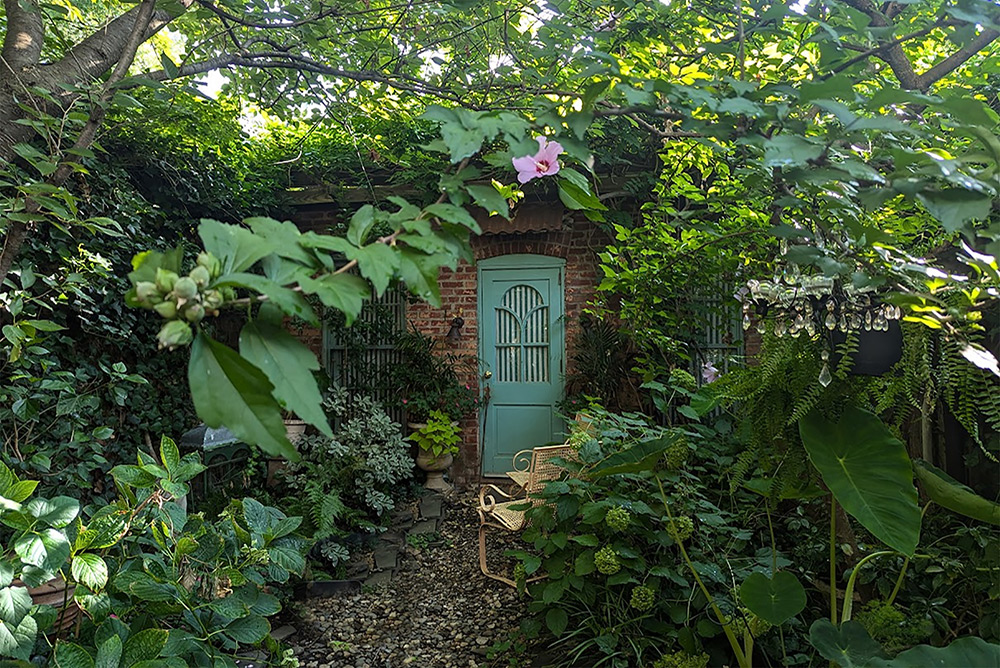
The Cavanaugh backyard, a shady paradise. / Photo by Stephanie Cavanaugh.

By Stephanie Cavanaugh

WELL, I THOUGHT, I could write about gardening. 

That was in June of 2016, when I was searching for a perch at Bird, and fashion, and food, health, and design had already been claimed. That was 504 columns ago. At an average of 700 words per story, that would be 352,800 words. That’s longer than any Stephen King novel except for The Stand.

I don’t know about you, but I’m impressed. 

Returning to the subject at hand: Sure, I thought, I have a garden and I’ve been planting and tending it for more than 30 years, though not always successfully. 

There was the blight of the apricot tree (not my fault, it came with the house) that was replaced by the kwanzan cherry,  whose massive canopy accounts for our lack of zinnias and sad roses.

I do adore invasives and have warned you and warned you—even while planting them myself. Wisteria is really irresistible. Oh, the scent. And honeysuckle, trumpet vine, and autumn clematis—which I did not plant, by the way; some seeds blew by from somewhere and said to theirselves: What a nice place to live. Loving that garage roof. 

I’ve done battle with postal-persons tramping across the front garden, careless dog owners, raccoons sleeping on the back-porch sofa, a family of opossums,  mice,  bugs, and feral cats.  

There was the, alas, temporary joy of my little greenhouse, where I could overwinter the jasmine, orange,  lemon, and flowering tropicals like hibiscus that I can’t live without. Built on a porch next to my office, home to my parakeets who flitted about cage free, it was my little slice of paradise. The scent on a sunny winter day was enough to put me in a coma. 

Permanent is the pleasure I take in our five window boxes, which change with the seasons, fancy with bows and lights at the holidays, spring and fall bulbs and pansies, and flowery summers.  The occasional fabulous fake. 

I’ve learned a great deal over the years, such as that potatoes can actually grow on those frilly potato vines we plant as ornamentals. I had one once. You can also cut up a sprouted potato, plant the bits and create a leafy border, for nearly nothing. And avocados? Did you know they grow on those plants you grow from pits? This has never happened for me, but it’s apparently so. 

The column has forced me to stay on top of the weeding and mulching, feeding and pruning. Ordering bulbs and falling for new plants. When I say me, I do mean me and My Prince, who digs the (deep) holes, schleps mulch and dirt, and often takes over the unpleasant work, particularly the clean-up, when I’m having the vapors and must lie on the porch sofa like a sleepy raccoon—but with wine and a book. 

Now we’re done, this is my final column. Editors Nancy McKeon and Janet Kelly will be working on Grownup Girl Fashion on the Substack platform, following style and beauty trends. I might contribute something, though I’ve been cautioned about mentioning peacock feathers.

What is life without peacock feathers? Shall we find out?

Total word count, 505 columns: 353,321.

While mylittlebird.com is finished, it still exists on line. For more of my stuff - I faint at the thought of transferring it all to here, just search the site under my name....

Kill the Gargoyles and Don’t Trip Over Fido: Aging in Place on Capitol Hill

The other day I was lunching at the Tune Inn with architect Judith Capen, to discuss aging in place, which has become rather a buzzword. Her home has been tweaked and gussied as architects will do, more open than ours, but still sharing many of the difficulties, and she always has…thoughts.

Wandering home along Pennsylvania Avenue we bumped into Nicky Cymrot, who has her fingers into everything around here, and a friend of hers whose name I have mentally misplaced, as I unfortunately do more and more often. She had on a fabulous fur jacket; I contemplated mugging her.

What are you up to, Nicky asked. We were discussing aging in place on Capitol Hill, I said. And we all babbled and tsked at each other for several minutes about the challenges older people face in our narrow, stair-plagued, homes. Failing to notice that none of us will see 75 again.

Older people, you know. Not us.

Let’s look at those stairs for a minute. Mine, since they’re handy.

My husband Greg and I live in a typical unrenovated row house with stairs to the front door, stairs to the garden, stairs to the basement, and stairs to the second-floor bedrooms.

There are no steps to the attic. For that we climb into an overloaded closet and up the shelves to push back a hatch to retrieve the holiday ornaments and whatnots. Oh, and the air conditioner apparatus is on the roof, reached through another hatch, in the ceiling of the second-floor porch. A ladder is required to change the filter. I do not do this but appreciate the effort of my spouse.

I imagine we all know someone that came to a tragic, even grisly, end on one or another staircase, which is why AARP’s Smart Guide to Aging in Place suggests living on one level, if possible.

On the other hand, if you still have balance, stairs are excellent exercise. There are people who pay gym memberships to climb them, while you have a free Stairmaster.

There are, in fact, many guides like AARP’s, with practical suggestions for modifying your home that are not too depressing. You should probably read them. The Capitol Hill Village also has resources including companies that will help you design a more accommodating kitchen or bath. The DC Department of Aging has a Safe at Home program for adaptive features for those over 60 or with disabilities. They say, “this may include handrails, grab bars, bathtub cuts, shower seats, and stair lifts.”

There are issues peculiar to The Hill, says Judith, particularly if you’re in the Historic District, where you run into issues of esthetics, an extra layer of hoops and permissions. But anywhere that modifications are needed – interior or exterior- permits must be obtained, which drive up the cost but will keep you safe. A chair rail that can’t support your weight? Oops, there goes the hip. And, as we’ve all been warned, there goes you.

Ten Tips for Making Your Capitol Hill Home Safer

1. Exterior steps.  Not only are ramps unsightly, but the slope must also be gentle enough that you can roll or walker yourself up or be pushed up without difficulty. To get a proper pitch, that would mean, Judith points out, starting it in the middle of the street. Once you’re permanently in a wheel chair, you’ll need more than a ramp to get in and around the house. If it’s short term, you could rent a chair lift. Or, just haul yourself up the stairs and have someone carry the chair. Good exercise!

2. For interior steps, secure railings are essential. If, like most of us, you only have a single railing, have another installed on the blank wall. Make sure it’s solid and professionally done so you don’t take it down if you stumble. Stair lifts can also be installed and removed without doing permanent damage to your home.

3. I love a good bubbly wallow in my clawfoot tub, but it’s become increasingly difficult to get into and out of. You could remove the tub and install a shower, which is expensive, and in my case, really sad. Or get a rubber tub mat and install sturdy grab bars. Elsewhere in the bath, toilet seats are easily modified, a higher seat makes lowering yourself and getting up again easier, though a lower seat does work those quads.

4. If you do not have a powder room on the main level, it might be worth the expense to figure out how to install one. If you’re space challenged, Acorn makes a sink with an integrated toilet that would fit in a closet. They also make them for prison cells so you know they’re fine in small spaces and should last a lifetime.

5. When attempting to see where you’re going, good lighting is helpful, and our homes are often short on natural light. Judith suggests using the brightest bulbs possible – though I’ll warn that bright light overhead can be very cruel to a face past its prime.  On the other hand, it’s useful in the bathroom, over the sink, for women getting at those little chin hairs and finding your lips so you can line them, and for men, shaving without cutting your throat.

Unless you’re sorting your jewels or maybe spring cleaning, strong lighting is generally not necessary in the bedroom, particularly if you still have a companion. You want to read in bed? That is why god created the Kindle Paperwhite, though I hate promoting anything Bezos.

6. Speaking of the bedroom. Make sure you can get in and out of bed easily. I am very fond of my Princess and the Pea mattress which is at Victorian height above the floor, but I confess it’s getting a little old. There have been nights when I have to drag myself up by my fingernails, which is neither easy nor seductive.

7. There are more ways to break your neck than stairs. Area rugs, for example. Perhaps you’ve met someone that’s skidded or tripped over one? Not necessarily a killer, but possibly a bone breaker. Clutter too. Do your kids a favor and get rid of stuff unless you’re the passive aggressive sort that lets them handle it after you’ve tripped over the cast iron gargoyle by the front door and landed in hospice. I cannot part with my gargoyle.

8. Dogs can be excellent for your health, or another hazard. Fido must be big enough to see without glasses (no more mini-poos) but not so large and energetic that you’re dragged down the block. A greyhound would be a poor choice.

9. Need the air conditioning filter changed, the gutters cleaned, the mattress flipped, the wisteria trimmed, the wine cellar restocked? Get over the macho stuff guys, hire a pro, or ask a neighbor or your kids for help. The city claims they’ll send someone to shovel your snow. Next time it snows, let us know how that goes. 

10. You don’t have to be a Hill dweller to appreciate a smart watch or medallion that can call 911 or an emergency contact if you fall. Just remember to wear it.

If it doesn’t make your skin crawl, consider a robot. ElliQ was recently written about in the New York Times. She sits on a table and learns to communicate like a new friend, learning all about you, reminding you of appointments, turning on the TV, playing scrabble, even writing your memoir if you wish. Produced by Intuition Robotics, is still being tested, but is being distributed by state health departments and non-profits that deal with the elderly…

But that’s not you, is it? It still ain‘t me, babe.

https://www.hillrag.com/2026/03/09/kill-the-gargoyles-and-dont-trip-over-fido/

MacKenzie-Childs Comes to DC


For: mylittlebird.com
FEW HOME FURNISHINGS companies can provide instant pizzazz the way MacKenzie-Childs can. “We leave no surface untouched, ever,” Rebecca Proctor, the company’s creative director, once told me. So true.
While bits and pieces of the line have been available in the Washington area for many years, and of course there’s a mail-order catalogue, we finally have a shop devoted to it: a jewel-box townhouse just outside of Georgetown’s Cady’s Alley design center.
Every square inch of the space is lined and heaped and festooned with a dizzying array of cake stands and candlesticks, vases and stools and over-stuffed poufs. Even umbrellas and eyeglasses don’t escape the painter’s brush—the pieces are hand-painted in the company’s workshop in upstate New York.
Most incorporate the line’s black-and-white checkerboard leitmotif mixed with polka dots, paisleys, plaids and stripes. The upholstered furniture sports swooping curves, painted legs and, frequently, fabulous tassels.
If you wonder what being Alice in Wonderland really feels like, wander on in.
It’s difficult not to smile, hugely. It’s also hard to stop buying the stuff—but you really must.  Drop a piece or two into a plain vanilla room and BOOM! Beyond that, you might pass out from the overstimulation—you can go nuts just looking at the pictures in the 103-page catalogue.
I personally find this stuff perfect for host/ess giving. A spatula with checkerboard handle is $30, a set of jolly canapé knives is $48. That’s the price of a bottle of something nice—but a gift that brings more permanent delight.
MacKenzie-Childs is at 1037 33rd Street NW, Washington DC 20007; phone 202-866-6565.

The Indoor Plant Shuffle


for:  mylittlebird.com

It’s once again time to contemplate bringing your tender plants indoors – or letting them die in peace, or place. With Halloween coming, the sometimes grotesquely charming withering of the fruits of your summer labor is an option to consider.

But first a note about tags.

Some months ago I rhapsodized about the surprising return of the ginger plants, which I couldn’t recall planting in the first place as they emerged in a rather odd location in the front garden.

Baby, adopting a superior attitude which one would not expect from one’s only child --for whom I forfeited my 21-inch waistline, not to mention the labor pains – wrote in the web comments on that piece that they weren’t gingers, but cannas that we had purchased last summer, on a trip to visit her and her Personal Prince Pete in Raleigh, North Carolina, Land of the Fried HoHos. She took three, I took three, and that’s how they came to be (that rhymes).

At the time, I also assumed that the stalks arising from another large pot were bananas, and I spent the rest of the summer fretting over their mingy growth.

How I can write a garden column and be such a lousy gardener escapes me. If I had put a tag somewhere in the vicinity of either I would have remembered that I was wrong about both.

So, Baby was in town this past weekend for the Women’s March – which she attended with My Prince while I was busily atoning for the family sins, being as it was Yom Kippur (an obnoxious and insensitive date to elect for any march relating to inclusivity, I might add).  Baby excused herself saying this is the way she chooses to honor the day (or some such). OK then. Trot your Irish half on down and take a knee for me in front of the Trump Hotel.

I’m getting to the point here, hold your horseradish.

As we were stepping out on Saturday night to break the holiday fast with friends she said something like, “Whoa Mama! Your ginger is blooming.”

And I said, “What ginger?” Since I assumed the ginger had expired (See paragraph 3).

But there, nestled in the pot that I thought was filled with recalcitrant bananas were three brilliant pink flowers nestled among the stiff green stalks.

This was very exciting and I pointed with my cane (which I claim is in use because of a trapeze accident) and said, “Move the ginger to the front corner, and the pot of bird of paradise to the back – I’m positive that they are bird of paradise even though they have no tags and have done precisely nothing all summer but sit in their pot and ask for water.

And she said, “Stop pointing with your cane, it’s obnoxious,” as she waddled across the yard with one pot and waddled back with the other.

The ginger certainly looks perky next to the front walk, a cunning complement to the pink geraniums in the window boxes.

Getting back to the subject of this piece, it is time to contemplate moving your tender plants indoors for the winter. May I suggest a nice merlot and a perch on the back porch steps while you do so. That always works well for me.

With a little luck, someone will show up and do it for you.


Green Acre #63: 10 Steps to the Perfect French Garden

No one Here But Us Chic-uns.

I GOT SO INSPIRED by Bastille Day last week, I began musing on the nature of the French jardin, preferably a Provençal one. Follow this simple path and be transported. Allons-y!

1. Start with a chair. You know the one. Bamboo framed and laced with black and white webbing. (It couldn’t always have been plastic . . . it must have been something else at another time. Lambskin? But plastic will do.) Set one or four in the garden and you have instant France—poof!


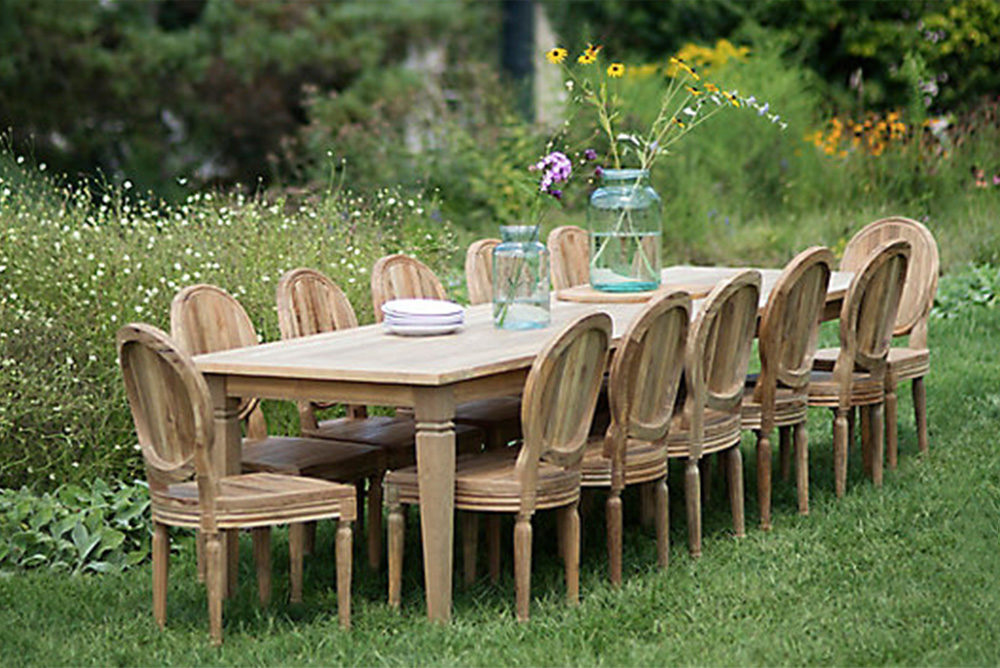
From Terrain, a 10-foot-long reclaimed teak dining table, $2,898 at shopterrain.com.
2. You do have two table choices, depending on the size of your patio. There is the classic round bistro table, the surface of which might be tiled, or wood, or stone. You may cover this with a French tablecloth; the cloths come in such lovely shades of orange and yellow and green and blue, with sheaves of wheat or lavender, but not tea pots, printed along the border. If you have space, consider a wooden farmhouse table of a length to seat 15 or 20, whatever is your usual Sunday dinner guest count. In this case, you might employ benches along the sides in addition to your café chairs.


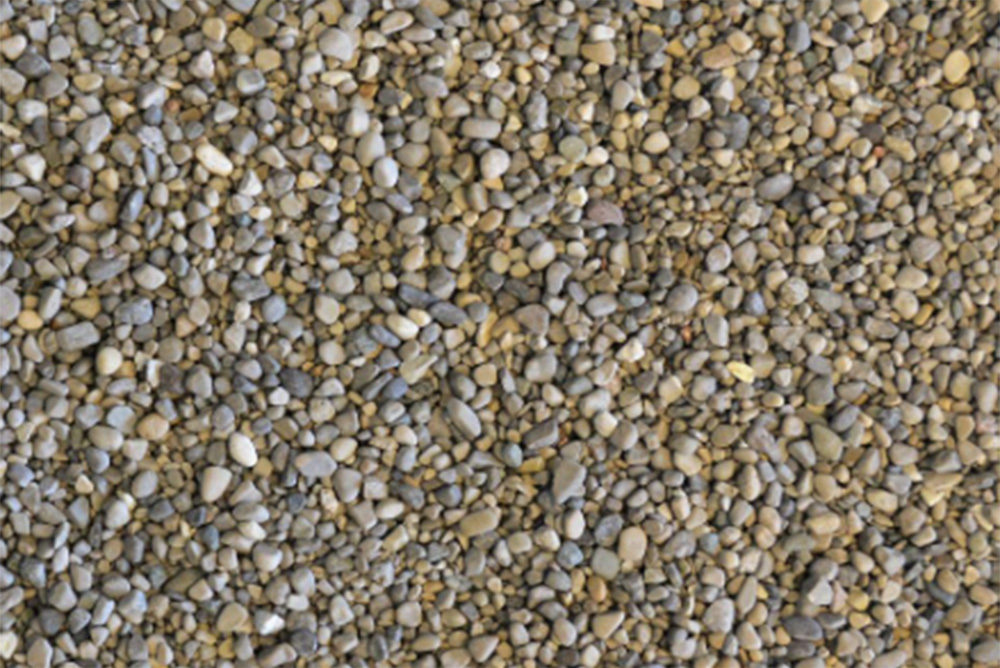
Bulk pea gravel is $333.50 for 5 yards (whatever that means) at The Home Depot.
3. Now, you need to set the table and chair upon something, and while there are surfaces that could pass—brick or flagstone come to mind—ideally you have pea gravel; the small, pale, tan stones that wedge in your espadrilles and dig a hole in your heel. Pea gravel is the ultimate French courtyard material. You come away from a walk across it instantly fluent in French. Ooh! Ow! Ouch! Or rather, Zut! Merde!


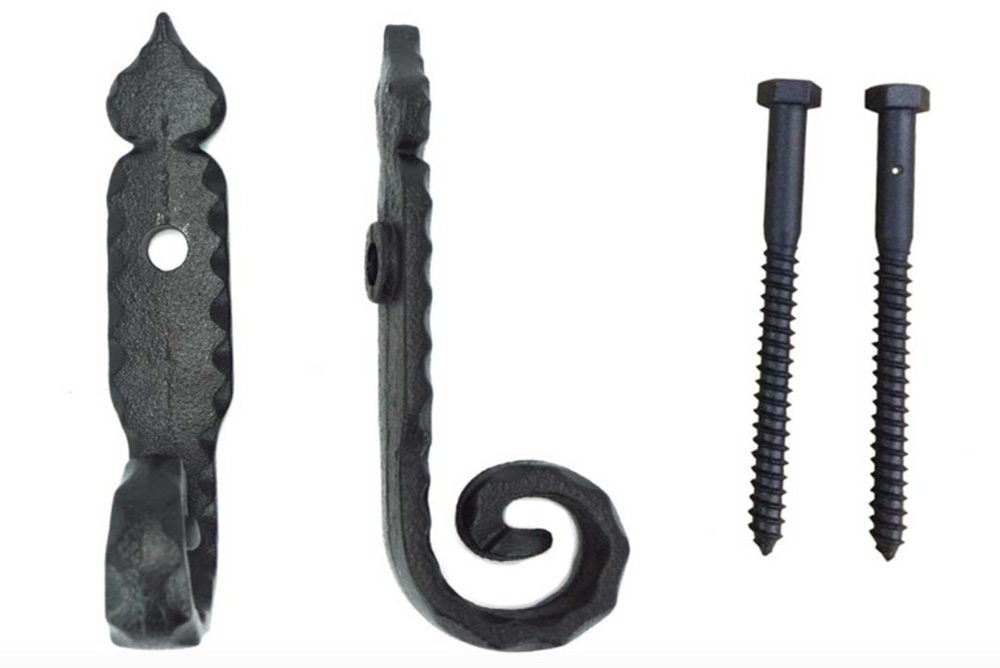
Cast-iron rat-tail shutter dogs, sold in pairs,  $18.50 the pair from John Wright. jwright.com.
4. Ideally, your house should be made of stone, with a bit of moss creeping up the walls, with very large shutters covering the windows. Americans tend to have wholly wrong shutters, far too small and flimsy to shut over the windows in the event of a storm, or to keep the icy blasts of winter out of the lounge. Your shutters must close over the windows, or at least look like they can, with cast-iron shutter dogs holding them open against the walls.

If your home is not stone, one would hope for brick. And the brick must be painted the lively colors of Provence. Take a cue from one of those southern French tablecloths and think Dijon mustard, tangerine or buttercup yellow paired with the clearest possible blue. The trim and the door and the body of the house have to zing off each other, but harmoniously, s’il vous plait. Of course, window boxes must be overflowing with blossoms that play with your color scheme.

5. While a case might be made for a border or pots of lavender, there is no plant more quintessentially French than the hydrangea, or more exactly, the blue hydrangea, which is the blue of an utterly cloudless sky after a rain, when all of the humidity has blown to Des Moines or Baton Rouge. You might flank the door with boxwood topiaries, or you can move the lemons and such from the orangery to the gravel for the summer, but the hydrangea is the essence of it all.
Now wield your secateurs and élaguer* a few branches for the table. Ah….
 
6. Yes. The table, by which I mean the table setting. Again two choices. Either white stoneware, the sort with the raised pattern along the border (I passed up a set at Miss Pixie’s reclaimed furniture a few years ago that I still kick myself over. Baby told me I had quite enough china. Oh, why do I ever listen to her?). Pair this with ivory-handled dinnerware and jelly glasses, and pick out a minor color from the tablecloth for your napkins, which must be cloth, not paper (see below).

Of course, if you’re lucky enough to have inherited Grandmère’s Limoges or Sèvres china and and her silver, this is a glorious place to set it. Matching is not essential; in fact, it is beside the point, which is above all the cultivation of unselfconscious chic. Fretting and fussing is so American; you must appear not to care. Squint a little, purse your lips and practice a Gallic shrug. Ne vous cassez pas la tête about it.

Big linen or damask napkins to catch the juices of the poulet are essential: They are easier to care for than you might expect. Wash them, fold them over once and stretch them flat. They will dry quite smoothly, and be softer to the lip than napery flattened with starch and an iron.


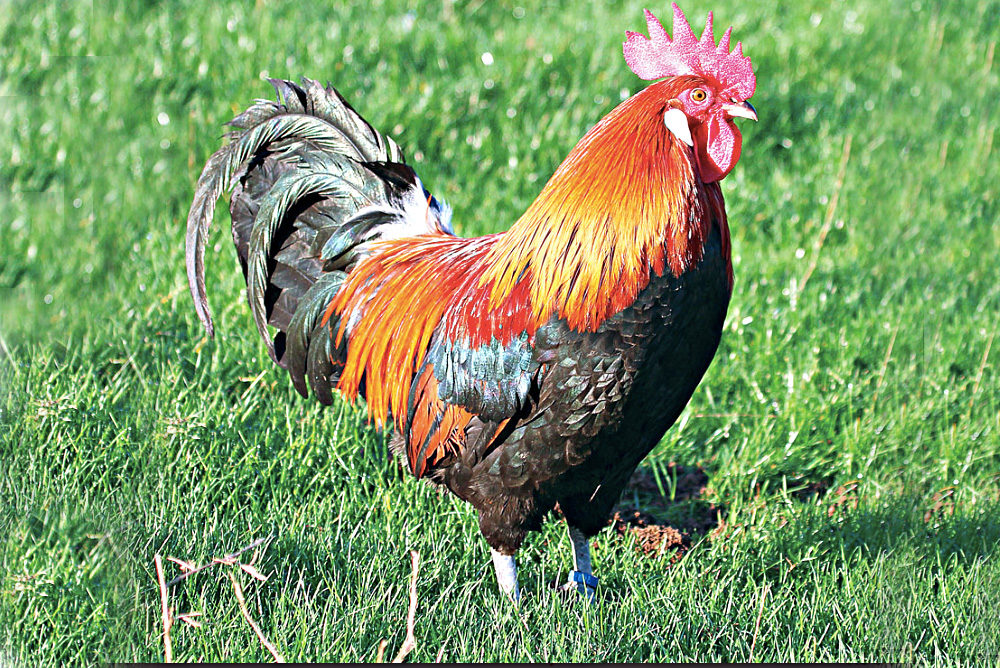
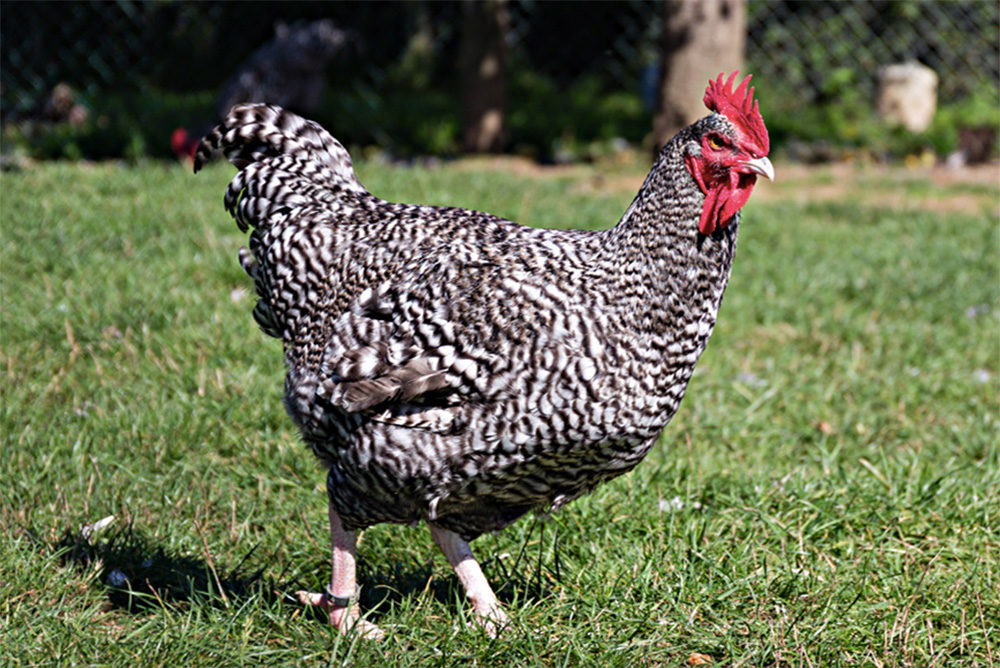
7. Ah yes, the chicken. I’m so glad I brought that up. You want to look really French? There is nothing like having a few chickens pecking the pea gravel. Consider the Coucou de Rennes, such fun to say! And the Gauloise Dorée sounds  decadently like smoking, which you really should take up. They’ll wander around your ankles as you dine, and if the clucking gets too irritating you can always eat them.


8. Now add music. While youthful French President Macron exhibits a fondness for the electronic dance music of Daft Punk, we’ll bet that First Lady Brigitte prefers Piaf. Create a Piaf station on Pandora and pipe it onto the patio. Pandora will automatically increase your level of cool, adding everything from Carla Bruni to Serge Gainsbourg to the mix.

9. Do have a ruin in the background, if at all possible.

10. You can also add olive trees, grapevines, fountains or a reflecting pool with swans. (Swans are important, without them the pool and garden might verge on Italian, which is somewhat similar, but much louder, and features lasagne.)

*Merci, Violette Capelluto-Schor. Élaguer means to prune.
—Stephanie Cavanaugh
LittleBird Stephanie often has visions like this. To read earlier visions (um, columns), type Green Acre in the Search box at the top of the page.

Green Acre #61: Beachy Keen

Watch Out for the Claws!

July 5, 2017
Tags: , ,
LittleBird Stephanie’s inspiration. Now if only she could find a claw-foot tub. / Photography © by Sabine Vollmer von Falken, from Shell Chic, © by Marlene Hurley Marshall, used with permission from Storey Publishing.
AT THE BEACH The Prince collects rocks and shells. He wanders, head down, sometimes for hours, looking not at the ocean, but at the bits washed up onto the sand. He’ll return to me, lying on a towel, nose to book, clutching his treasures.

“Look at this one!” He’ll say of a craggy gray hunk of something. “It’s millions of years old,” he’ll tell me, eyes bright with wonder.

“Yes,” I’ll squint up at him. “It is. Wonderful.” My approval pleases him.

“And this one, the color!” he’ll sigh. Of course it’s wet, and therefore is shiny, and the lovely coral hue will fade as it dries. But I don’t tell him, why pop his bubble? He’s just a happy boy at the beach.

Going to the beach for us usually involves an airplane to Florida where Number One  Sister perches eight floors above the least-crowded stretch of sand in South Florida. Here we can sit on the front terrace and see hardly a single soul.

We’ve been visiting her here every year for the 25 years or so since she moved south from New York. Being beach people, we have made numerous tropical island hops between times. That’s a lot of rocks and shells. Most of them, in my snooty opinion, not in the least worth the effort. And all of them have to be heavily hauled, dragged, schlepped and shoved onto the plane home.

At home, the bags are emptied onto the back porch, where the collection sits in sandy memory until I figure out where to hide them. Dump any one of our garden pots and you’ll find a layer or two of who-knows-what-from-where, serving as drainage.

On a side trip one year to Key West, we were wandering along Duval Street just where clever and cool met T-shirt honky-tonk and came upon a little shop whose entrance was marked by a small claw-foot tub encrusted with shells.

These were beautiful shells, perfect—scallops and bullas and little conchs, even the shells that were cut in half to expose their inner whorls and pearly centers were precisely measured. They were all shades from tawny and tiger-striped to white, and interspersed with pearls and bits of sea glass that caught the sunlight.

I was overcome with the thought that this was either one of the most fabulous things I’d ever seen or a tacky margarita-fueled horror that would only be considered wonderful here in the Conch Republic, or a Carl Hiaasen novel. *

Meanwhile, I fantasized it into the middle of the garden back home. A wallowing pool. For me. If I’m being honest, unless I’m lying facedown in the water with a mask staring at fishies, I rarely do anything at the ocean besides sit in the water and read—sometimes I stand and read, if I need exercise. I can just as well do the lying about in a tub, surrounded by ferns and jasmine and parlor palms, bringing the tropics to Capitol Hill. One can make a margarita anywhere.

And it’s practical! When I’m done for the day, I figured, just pull the plug and water the plants.
There was even a how-to book handily for sale at the shell shop, with instructions for encrusting your own tub (or bird bath, chandelier or grotto) with shells. Shell Chic, by Marlene Hurley Marshall, with photos by Sabine Vollmer von Falken, is still for sale on Amazon. It was brand new at the time, August 2002.

All we needed, besides $35 for the book, was a claw-foot tub, rustproof paint, a ratchet gun (What’s that? Ask the Prince), silicone adhesive, beach glass, pearly beads and shells. A whole lot of shells.
But a creative snap! I thought, studying the diagrams.

So in addition to his usual bag of rocks and shells, we now had my bag of shells—collected at shops with cunning names like Shell World and Joyce’s Shells & Gifts, places I had theretofore averted my eyes from, along the 98 miles between Key West and Key Largo and the highway north to Sister’s.
I recall being eager to get home and begin, a sop to vacation’s end.

Only guilty reminders remain of this project: A strand of cowries, I think they’re called, hanging on the back porch; heaps of loose shells, many now broken, in the dusty wicker basket I like to think of as my craft box; and strands of fake pearls and bits of sea glass.

I suppose I could have glued these bits to something else, but my enthusiasms often fade as quickly as they appear,  particularly when it comes to arts and crafts. If it can’t be done in 10 minutes with a paint roller or extra-large knitting needles, forget it.

Meanwhile, My Prince, bless him, continues to keep an eye out for that claw-foot tub. Amazing that despite how everyone seems to be tearing them out for glass-walled showers the size of small rooms with benches and multiple heads for rain and steam and hoses for the hard-to-reach spots, old claw-foot tubs are both hard to find and bloody expensive. Shouldn’t he have found one in the trash by now?
—Stephanie Cavanaugh
LittleBird Stephanie says that her next column will feature five almost-instant ways to wallow in water in the garden—maybe 10, if she can think of that many. 
* If for some reason you don’t know who Carl Hiaasen is, go immediately to the library or a bookstore and enjoy.

Green Acre #62: The White Garden

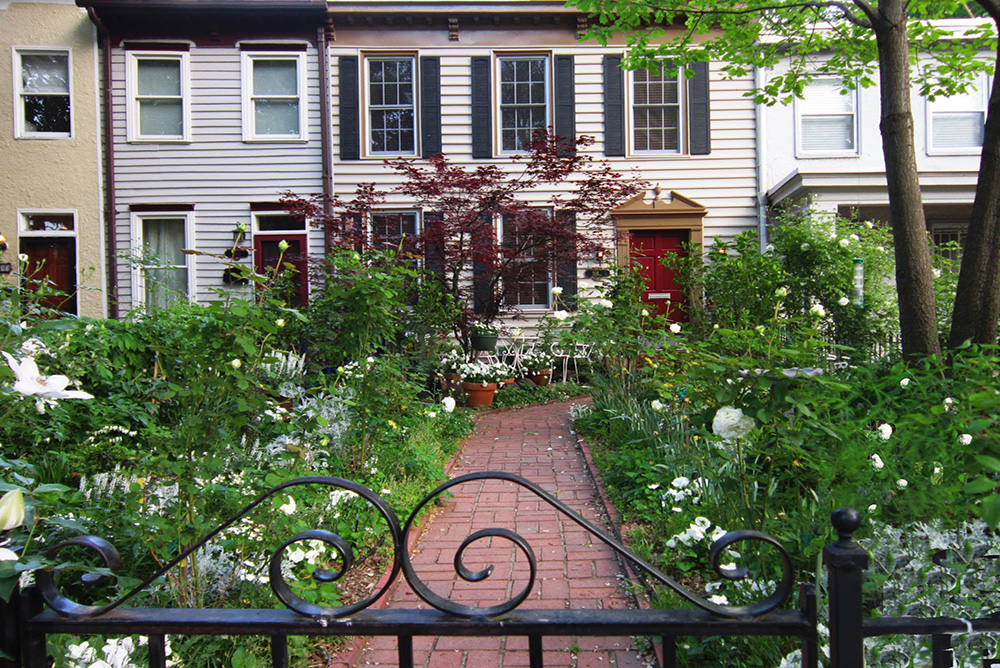
This house in Washington DC has captured the magic of the white garden. / Photo by Stephanie Cavanaugh.
I KNOW I SAID I’d write more about pools this week, but it’s too hot. Join a pool. Fill a copper horse trough and splash about. Run through a sprinkler. Think cool thoughts. A white garden helps with that.
If you’re otherwise occupied during summer days when the flowers bloom,  and as often as not away on weekends or busy being air conditioned, a white garden brings magic to the night.

A few blocks from me on Capitol Hill in Washington DC is a small frame house, painted white, with black shutters and a red door, very country in the city. A long brick path leads from the front gate, wandering through a border that only flowers white, from early spring through fall.

The mix of blossoms is simple enough: The early peonies are met by great sprays of white clematis with faces the size of salad plates; these tumble together with repeat-blooming white roses over the black wrought-iron fencing, then frolic their 
way through the border greenery, with dusty miller providing a silvery accent.

Pots of white impatiens stationed along the walk can be moved here and there to fill in the inevitable gaps left by a summer vacation.

A helpful sign is posted on the gate, explaining what you’re plainly seeing but, given the oven-like heat, may not have the mental energy to comprehend:
“The white garden is an informal gardening style that is similar in design to the English cottage garden. The open and informal design creates associations with romance, peace and elegance. The white flowers are mildly and densely spread throughout the garden’s green areas, creating a luminescent sight that is especially powerful in the twilight.”

In this case, twilight is prolonged by the soft glow from the lamp posts along the sidewalk, the flittering of fireflies, and the twinkle of little white lights in the red-leaf maple beside the front door, which frills above the patio table and chairs.

Beyond brilliant, white flowers can be fabulously, devastatingly, decadently perfumed, and usually most powerfully scented in the evening or at dawn, just when you’re around to enjoy them. Consider jasmine and lilies, honeysuckle, moonflowers and nicotiana, orange and lemon and grapefruit (if you have a sunny spot to winter them over)—all are white, or available in white.

One could pass out from such a cacophony of scent, lying there like Dorothy in the field of poppies leading to Oz.

Yes, I know her poppies were red. Stop being so literal. It’s tiresome.
—Stephanie Cavanaugh
LittleBird Stephanie writes about her garden and the gardens of others, as the mood hits her. You can read earlier Green Acre columns by typing Green Acre in the Search box at the top of the page.